
First Principles and First Values
an overview of David Temple’s cosmology, in comparison with Brian Swimme’s evolutionary cosmology and Richard Tarnas’s archetypal cosmology

I first came across Zak Stein at the McGilchrist Conference in March 2024. A friend recommended checking out his and Marc Gafni’s book, given my dissatisfaction with how the many speakers evokes universal meaning without specifying its particular forms beyond the familiar triad of Truth, Beauty, and Goodness.
I had yearned for more indications of fellow-travelers seeking a grand yet pluralistic consilience of world knowledge and wisdom. This book offers it.
In this essay, I provide a comprehensive overview and consolidation of what the book covers, providing sources and asides in the footnotes. I conclude with brief summaries of other philosophers’ similar projects: Robert Swimme’s evolutionary cosmology and Richard Tarnas’s archetypal cosmology.
In a follow-up essay, I will dive into specific critiques, comparing the three cosmologies. Their similarities and differences are instructive of how each may develop further from each others’ strengths and deficits.
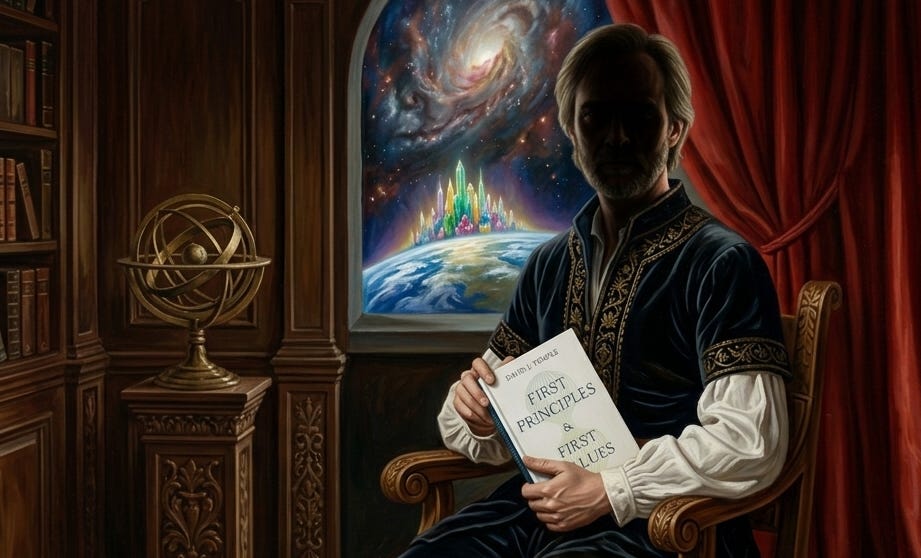
First Principles & First Value is the first published work of a collaboration between Marc Gafni and Zak Stein, under the pseudonym David J. Temple. His primary goal is to articulate a new cosmological vision, a project that they call CosmoErotic Humanism. The book outlines the core ideas of their project, which they plan to elucidate further in future volumes.
The Meta-Crisis Worldview
The foundation of Temple’s philosophy would be familiar to anyone with knowledge of the many movements and figures who view the dominant secular worldview as destructively inadequate.1 I largely subscribe to his perspective, and found his articulation of it incisive:
Science has offered unprecedented advancements in human’s command over the natural world, but its success has led to a unilateral belief that only what it can describe is real. It has split off inquiries into subjective experience as relevant only to the Humanities, expressing skepticism and dismissiveness to their relevance to the hard, empirical facts of reality. Further, postmodern philosophy has emphasized the deconstruction of all subjectivity, the grand narratives and values that once undergirded civilization. In turn, these big-picture stories are at best viewed as contingent and contextual, at worst as justifications for power and dominance.
As a result of this overriding skepticism and cynicism towards higher values, we have been thrown into a crisis of meaning.
In an attempt to resolve this existential dilemma, some pursue an often-dogmatic return to old traditions and will to power, while others accept our relativistic conditions and implicitly endorse practices that limit value to the instrumental maximization of pleasure and convenience.2
These one-sided approaches are due to the absence of a centering story of meaning and purpose, a common ground from which the best of rightward3 and leftward4 values can be dialectically held in tension and reconciled. As such, neither approach can transcend the acute crisis that seems to be upon us, an interregnal time between worlds: the old dead values behind us, with unbearable uncertainty ahead.
As it stands, nations and institutions pursue their own short-term and conflicting ends, alienated from externalities and long-term consequences, producing an overly complicated and fragile global system that cannot be coordinated towards the needs of the whole earth.5 In consequence, there are a multitude of exterior crises to overcome:6 “a catastrophic depletion of biodiversity”7 due to resource extraction and climate change; the mutually assured destruction of nuclear war among competing powers; and the threat of “planetary-scale TechnoFeudalism”8 as a globally empowered few may come to control the many through advancing surveillance and bioengineering technology.9
These conditions are not without precedence. Since the emergence of human consciousness and the rise of civilization, there has been an oft-catastrophic split between humanity’s exterior, objective knowledge of the world10 and our interior, subjective experience.11 Temple sees this split originating with early human consciousness, the emergence of self-awareness and its alienation-inducing distance from ourselves and the world at large. This was compensated for with the rise of religion, sacred principles that allow us “to reconnect, realign, with the nature of reality.”12 While we have overcome this divide before, “if our civilization unravels it will be a failure of an entirely different order: a global failure.”13
The Revitalization of Value
In response to the overreaches of scientism, ideology, and nihilism, Temple argues that these immense challenges require a return to meaning and purpose, a “(re)thronement of value and consciousness as primordial to Cosmos;”14 “a profound return to reality … humanity once again brought back in touch with how the Universe works, for better or worse.”15 Balancing the extremes of dogmatic totalitarianism and hedonic permissiveness, they see values and principles as not arbitrary or fictive, but foundational to reality itself; inherent “oughts” of existence that form the “field of value” we must align with.16
This revitalization of value must be globally agreed upon to meet our global challenge, to overcome parochial adherence to some or one value over other(s), which produces rivalrous conflicts, tragedies of the commons, multipolar traps, and races to the bottom. It requires a move beyond a tragic recognition of our devastating conditions, through denial and resignation, towards hope for renewing possibility.17 Further, Temple sees it as insufficient to outline these values prosaically. They instead seek the creation of a new “story of value,” as only narrative can “generate coherence [and] arouse our moral and political will to action.”18
They frame this story in terms of four ‘big bangs’: the first bang of Matter studied as physics and chemistry, the second of Life studied as biology and ecology, the third of Mind studied as psychology, and the fourth of a still-emerging conscious awareness of our cosmic unity.19 They form an ‘evolutionary chain’ towards greater exterior complexity and interior consciousness,20 exemplifying the manner in which the Universe is driven towards greater self-organization,21 of which we play a part as cosmic self-actualization.22
From this general foundation of post-post-modern perspectives,23 they put forward an approach towards a new worldview that is unlike the projects I’ve found among their fellow travelers.
Other thinkers tend to focus on the discontinuous evolution of the world and worldviews, from the pre- to post-modern, and how to “include and transcend” their best approaches to reconstruct meaning and purpose.24 In contrast, Temple additionally puts forward several specific fundamental principles25 and values26 that they see as continuous across the ‘big bang’ levels of complex organization—a trans-scalar, complex typology.
They see these first principles and values as what the universe aspires to become, not just a description of what it is. The latter emphasizes beingness; the ad hoc, contingent particulars of structures and mechanisms. The former emphasizes the directionality of the patterns and processes that correspond at different scales.
In this way, the first principles/values are not static and fixed; they are dynamic within the ever-changing paradigms of our diverse world, which Temple calls an ‘evolving perennialism.’ In brief, first principles/values are paradoxically both eternal and evolving, being and becoming, contingent and purposeful. Each of the principles’ and values’ manifestations provide a foundation for further emergence, taking discontinuous leaps into novel structures and mechanisms, while maintaining continuity in their general qualities and outcomes. As we’ll see, the Intimacy of atoms forming molecules is quite distinct from that of humans forming a family, but both share the value for integrating into larger wholes.
This cosmic evolution is not towards any definite ends; it is a general process of increasing complexity and consciousness, each intertwined and informing the others’ transformation, with no guaranteed or predestined trajectory. Temple further argues that there are choices to be made by individual agents like us in this cosmic story; to participate in its growth or regression.27
The values they present pull from the perennial wisdom of past traditions,28 the natural laws and sacralized common sense of modernity,29 and contemporary insights of modern science.30 Temple argues that each of these were incomplete; they were too parochial,31 too anachronistic,32 too abstract, too practical, or too implicit;33 but in the wake of postmodern deconstruction, there is a clear ground for fresh inquiry and explicitly articulating values “that survived and thrived despite modernity’s attempt … to undo value.”34 This itself is evidence of their existence underlying all of reality, bridging the particular and the universal, the immanent and the transcendent.35
By articulating these values in a new form, Temple aims to offer a ‘universal grammar of value’ that applies to all of the cosmos while allowing for unique, individual expressions.36 With these values, conscious evolution can proceed from an awareness of the evolutionary processes we live in, as, and through—allowing us choose to align with them. Their telos aren’t inevitable; the infinite ways first values and principles may manifest suggests their contingent nature, open to the free choice of our engagement, for better or worse.
In order to recognize the correspondences of first principles and values across the evolutionary chain, we must develop what Temple calls an ‘Eye of Value,’ which emerges through an epistemological methodology they name ‘anthro-ontology.’ They define it as a recognition that our human experience does not merely analogize exterior reality, but that objective appearances and subjective states are deeply intertwined.
As I would argue for it, it is not (always) mere anthropocentric projection to view non-human patterns and processes in terms of our interiority. If we accept that we are an extension of the general evolutionary development of the cosmos, not exceptions to it; and the developing universe exhibits corresponding patterns across scales of complexity, despite their material differences; then it is reasonable to conclude that parallels among third-person, principled knowledge about reality also implicate first-person value-laden experience of that reality.
Temple outlines seven key steps of their anthro-ontological method for moving from common sense intuition to arguing a principle and value is universal. I find their particular order unnecessarily confining;37 nonetheless, I appreciate each part of the search they name as important. As Temple says himself, “the deeper currents of truth [are] always already [a]live within us,”38 and so there are likely many paths towards them.
The First Values and Principles
Temple names two sets of first principles and values, those of a “First-Order” and a “Second Order.” They see their list as partial and open-ended, subject to further revisions.
First-Order Cosmic Principles are the “most basic given realities of subject and object, of Being and non-being,”39 which “can be found throughout intellectual history”40 as “an emergent, overlapping consensus … on what an adequate metaphysics looks like.”41 These principles are given brief descriptions and are implicit in both Temple’s portrayal of the stakes and methods of CosmoErotic Humanism, so I will pass on from elaborating on them further.
Second-Order Cosmic Principles are the primary ontological categories and particular expressions of the cosmos. Eleven Second-Order Principles are listed with a core equation that distills their meaning. These include uniqueness, eros, intimacy, desire, relationship, evolution, harmony, personhood, freedom, story, and integrity.
Of the eleven named values, eight are given a few pages of description each. Given the book is titled for these concepts, and they were central to my interest in Temple’s project, I was hoping for more explication on their natures. As it stands, I look forward to reading future publications that explore them further.
In the meantime, the principle/value of Intimacy is given an extended treatment in the book’s introduction, and so I’ll focus on it here.
The First Principle and Value of Intimacy
Temple defines Intimacy as “experienced by human beings when individuals share an identity in the context of relative otherness, in which there is mutuality of recognition, feeling, value, and purpose.”42
Using the family as an everyday example, they extend this common, first-person experience as a reflection of the move towards intimacy seen among quanta, atoms, molecules, cells, organs, organisms, ecologies, nations, communities, and organizations — each governed by the same core tenets of shared identity, values and purpose in manifestly distinct ways.
These connections come from Temple’s anthro-ontological approach. For example, they see sub-atomic particles having “a proto-desire to touch and form larger unions,” and atoms “‘choosing’ where and how to merge and fit together.”43 Biology rests on the configurations of intimacy between non-living and living parts that permit a mutuality through their interdependent integration into larger webs of life. On the psychological level, they connect Attachment Theory to this First Principle, which outlines how “the love and attention of a caring, mothering presence”44 is necessary for survival. Organizations like nations exhibit the same need to share a ground of value and purpose. They also view the studies of systems, chaos, and complexity as “mathematics of intimacy,” how independent entities can spontaneously self-organize into goal-directed wholes.
Temple distinguishes intimacy from fusion, homogenization, and merging, placing Intimacy and allurement in a dialectical dance with autonomy.45
For each principle/value, they provide an equation that formalizes their complexity within discrete interrelated terms, to be unpacked in later writing:
Intimacy = Shared Identity x [Relative] Otherness x Mutuality (Recognition + Feeling + Value + Purpose)46
In sum, I find Temple’s presentation of the current stakes of meaningmaking, and his methodologies for its rediscovery, equally comprehensive. While I may expand on some points or refine others, my summary of his work largely aligns with my own thinking.
His cosmology shares many similarities with those of Brian Swimme and Richard Tarnas, philosophers whose projects have converged on similar visions of the current worldview, its deficits, and the tools for envisioning a better one. I will share brief summaries of their work here, and provide deeper analyses in the next essay, where I critique Temple’s cosmology in terms of what Swimme and Tarnas provide with their own.
Swimme’s Evolutionary Cosmology
Brian Swimme is a professor emeritus of the California Institute of Integral Studies. He wrote extensively and produced documentaries on the epic of the universe’s evolution, framing modern science as a revelation of how humanity and consciousness continue the unfolding of the cosmos. As a trained astrophysicist, Swimme has approached the discoveries of science with a poetic lens, elaborating on the implications and felt-sense of scientific facts towards their existential intimations.
He presents his work as an alternative to the cosmology of science, industry, and militarism—a story of instrumental use and commodification, producing great destruction and alienation. He argues for a resacralization of the cosmos through stories that reconcile the insights of spiritual convictions and scientific knowledge. Like Temple, he speaks to the metacrisis of the current age, and sees the romance of storytelling as a reparative path towards a more holistic, planetary worldview.
In his lecture series The Powers of the Universe, Swimme lays out eleven organizing principles underlying the universe’s development: Seamlessness, Centration, Allurement, Emergence, Homeostasis, Cataclysm, Synergy, Transmutation, Transformation, Interrelatedness, and Radiance.47
Swimme employs the same multiscalar approach of Temple’s CosmoErotic Humanism, seeking correspondences among physics, biology, and astronomy. He similarly names alignments between subjective experience and objective facts, risking the same anthropomorphism that Temple’s anthro-ontology works to address systemically.
Tarnas’ Archetypal Cosmology
Richard Tarnas is a professor emeritus of the California Institute of Integral Studies. He is best known for his 1991 Passion of the Western Mind, which explores the dialectical evolution of philosophical thought from the Ancient Greeks to the contemporary era. In 2006, he published a sequel, Cosmos and Psyche, applying an astrological lens to his historical research.
Tarnas argues, like Temple, that we are amidst a multidimensional crisis, affecting all aspects of life: the economic, ecological, psychological, social, and spiritual. We thus require a new coherent worldview to overcome the hyperrationalist myopia and arrogance of our planet- and soul-destroying techno-consumerism.
According to Tarnas, the original human worldview characterized the cosmos as alive. For our first ancestors, the inner mirrored the outer and the above reflected the below, mutually implicating one another. The development of reason and instrumentality fractured this felt unity into persistent schisms: self from other, human from nature, spirit from matter. In order to recover from this alienation, Tarnas aims to rehabilitate metaphoric and symbolic thinking as essential tools in a participatory epistemology.
If the inner and outer are inextricably intertwined, each expressing the same underlying dynamics, then every aspect of cosmic evolution can be understood in parallel to the others. Astrology is, for Tarnas, the most ancient and systematic practice for observing this correspondence. It is a framework for recognizing the cyclic patterns of personal and world events in terms of primordial “first principles”48 that Tarnas calls archetypes, signified by the planets, the Sun, and the Moon.49
While Tarnas and astrology emphasize the qualities of time’s progression in relation to the planets’ cycles, he also articulates the planets’ atemporal and abstracted associations with profound depth and breadth, implicating a multiscalar appreciation of their physical, psychological, and social patterns and processes. In this sense, the planetary archetypes are a plurality of axioms that are much like Temple’s first principles and values, which can be perceived through the opening of the ‘archetypal eye,’ much like Temple’s ‘eye of value.’
ITemple, Swimme, and Tarnas each diagnose the problems of our current age—its loss of value and meaning, its fixation on instrumental use and superficial pleasures, its destructive exploitation of nature and humanity—in terms of a missing or insufficient worldview. They argue that overcoming our multiple crises requires the birth of a new holistic paradigm, one that can reconcile scientific facts and spiritual wisdom to resacralize the cosmos. Towards this end, each presents a complex universal typology to rise to the occasion, one that permeates each scale of the cosmos, from the physical to the social, the objective and the subjective.
Whether called a principle, value, power, or archetype, these general axioms are posited to be legible throughout the cosmos, the evidence of an underlying meaning and purpose of existence.
At the same time, there are meaningful differences in the axioms each thinker presents, which I will explore in my forthcoming critique. Whether those differences reveal the limits of each project, or the outlines of something more complete, is what I will take up next.
References
Swimme, Richard. (2004). The Powers of the Universe. Center for Story of the Universe.
Tarnas, Richard. (2007). Cosmos and Psyche. Plume.
Temple, (2024). First Principles and First Values. World Philosophy and Religion.
Gafni and Stein’s fellow travelers of the Integral and Metamodern movements most evidently share this worldview, but I’ve come across several like-minded thinkers before learning of their work: psychologist Carl Jung across his writing, neuroscientist-philosopher Iain McGilchrist in his Master and his Emissary, biologist E.O. Wilson in his Consilience, complexity theorist Stuart Kauffman in his Reinventing the Sacred, psychologist Jordan Peterson in his Maps of Meaning, and of course, Richard Tarnas in Cosmos and Psyche, and Brian Swimme in his Powers of the Universe series.
goods and services, bread and circuses—the paradigmatic neoliberal, end of history promise, which loosely aligns with more radical hopes for post-industrial luxury communism: endless ease and pleasurable satisfaction
enduring order and tradition-inclined
generative chaos and progress-inclined
Chapter 9
This list is not exhaustive. These crises may be sliced and boxed in many ways, among many causes and imagined solutions.
p. 28
p. 29
p. 93
studied by STEM science
studied in the humanities
p. 47
p. 44; “within two generations [we] will likely experience the end of life as we know it,” p. 10
p. 10
p. 26
As I have argued, they can be seen as fractal attractors that are inherent to cosmic unfolding.
Chapter 7
p. 57, also described in Chapter 11
Chapter 12; in contrast, Gregg Henriques offers the same first four levels of his Tree of Knowledge system, but sees the fourth more descriptively as a level of Culture and social systems, not aspirationally as Temple does
p. 108: “reality is composed of both interiors and exteriors, all the way down and all the way up the evolutionary chain.”
p. 114: “evolution yearns for more and more consciousness”
p. 105
not to suggest all are embraced by Temple’s Integral-Metamodern colleagues; the “pan-interiority” of the cosmos, subjectivity existing prior to life, is hotly debated, for instance
as seen with Integral’s Spiral Dynamics, and Neo-Paigetian models of consciousness development
outer forms
inner telos
I’m more agnostic on this point about free will, but see it as a pragmatically correct position for promoting individual responsibility over resigning oneself to cosmic fate or empowering amoral action
pp. 5-6: “a common core of truths that can be found within all the best works of human’s religious imagination and interior sciences of contemplation”
life, liberty, equality, agency
Chapters 15 to 19
p. 120: “the general ethnocentric presupposition of every [pre-modern] religion was that it alone has the clearest, most direct access to the source of all value”
p. 150: perennialism excludes the wisdom of embodiment, democracy, universal human rights, sexuality, the feminine…
p. 139: “common-sense sacred axioms … are background assumptions upon which we predicate all our communications, decisions, and interactions”
p. 154
p. 157: “postmodernity’s savaging of value was not for the sake of deconstruction in and of itself, but rather for the sake of reconstruction, … for the sake of the evolution of value itself”
p. 7: “CosmoErotic Humanism is not a totalizing or homogenizing project. It is rather the (re)valorization of richly diverse and unique personhood-and the (re)uniting of personhood with the intrinsic values of Cosmos”
i.e. beginning with deep introspection before seeking transcultural similarities or biological evidence
p. 240
p. 164
p. 165
p. 165; their list includes perspective-taking, temporality vs. eternity, the hidden vs. the revealed, wholes vs. parts, interiors vs. exteriors, polarity and paradox, and better vs. worse values.
p. 11
p. 17
p. 21
p. 15; though autonomy is not described as a first principle itself
At first glance, this equation strikes me as more mystifying than clarifying; even if I were familiar with Temple’s comprehensive explanation of it, holding all the parts together seems like a demanding mental task. Further, these formulas imply that the First Principles and Values can be defined linearly, contradicting the inherent nonlinearity that modern physics indicates is cosmically primary. I will, however, withhold my full judgment until more writing on the formulas is published.
p. 84