
A Threefold Cosmological Critique
on the Ambiguous Distinctions, Unilateral Goodness, and Asymmetrical Valences of David Temple’s First Principles and First Values

In a previous essay, I lay out my summary of CosmoErotic Humanism. Now, I will turn to my critiques.
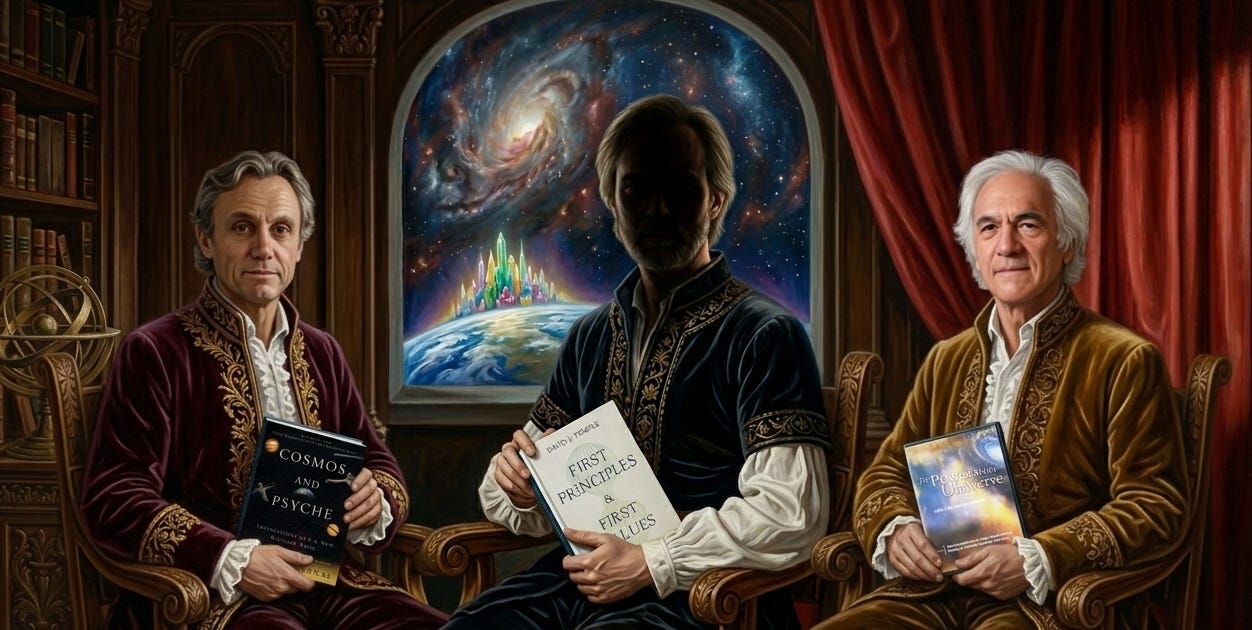
To do so, I compare Temple’s projects with two of similar motivations and presentations, Brian Swimme’s evolutionary cosmology and Richard Tarnas’s archetypal cosmology. I outline what I see in Temple’s project that may require more clarification or reformulation, in light of Swimme’s and Tarnas’s own approaches toward complex typological cosmologies. I conclude with general observations across the three projects, with recommendations for each.
The Ambiguous Distinctions of First Principles and First Values
Many of the principles and values that Temple outlines appear mutually implicating to the point of conceptual overlap, making it difficult to understand them in themselves. While it is reasonable to see fuzzy boundaries among abstract and broad qualitative concepts, I am left wondering to what extent the principles and values represent distinguishable centers of meaning.
For example, the first principle and value of Eros appears to be the most fundamental, frequently appearing in the equations of other principles and values.1 It is defined as an outrageous love that permeates reality, the very impulse through which the unfolding of the cosmos occurs. It is the basis for the Desire for deeper Intimacies, the impulse for discrete parts to come together into greater wholes in mutual recognition and a shared sense of experience. This process leads to the formation of Relationships, requiring a Harmony of communion and connection with autonomy and separateness.
Intimacy, Relationship, and Harmony are their own first principles and values, but they appear to be inextricably linked in their telos, describing separate aspects of a single process. Perhaps with more concrete examples, I could grasp how these principles and values can operate in distinct ways, just as the principle/value of Desire can be for Freedom as much as it can be for Intimacy. Given what Temple’s book provides, the distinction remains unclear.
In contrast, Swimme’s cosmological power of allurement seems to portray Temple’s Intimacy, Relationship, and Harmony as aspects of a singular power:
Allurement is the power of attraction, represented most fundamentally as the force of gravity, warping space-time to draw masses together. He sees it as a power that generates intimacy: that of life on earth orienting to the sun for its energy, or that of sexually differentiated species forming unions to procreate, the primal arousal and erotic desire for another.
At the level of psychology, lust is sublimated into romance, the drive to harmonize into an intimate relationship, producing passion, and even absorption with the other. Further, we can be allured to communities, places, and ideas, anything which we see as beautiful and good.
Similarly, the archetype of Venus covers a similar territory of meaningful associations. Named for the Roman Goddess of love, Tarnas describes Venus as
the principle of desire, love, beauty, value; the impulse and capacity to attract and be
attracted, to love and be loved, to seek and create beauty and harmony, to engage in social and
romantic relations, sensuous pleasure, artistic and aesthetic experience; the principle of Eros2
In this brief description of the Venus archetype, relationship, harmony, desire, and Eros are explicitly constellated together. Further, astrologer Howard Sasportas sees Venus in terms of the dilemma between ‘intimacy’ and ‘autonomy,’3 as Temple describes “a yearning for intimate communion—in a dialectical dance with the desire for autonomy.”4
One conclusion to draw from these comparisons is that Temple may be pursuing a more rigorous differentiating of first principles and values than either Swimme and Tarnas. In describing Intimacy, Relationship, and Harmony as distinct, he aims to systemize the otherwise looser entrainment of qualities and themes represented by the Allurement Power and the Venus Archetype. This is a worthwhile task; planetary archetypes in particular often rely on the intuitive clustering of concepts, often lacking the support provided by independent fields of inquiry.
At the same time, I wonder to what extent formalizing the distinctions among Intimacy, Relationship, and Harmony provide a meaningful difference in the general goal of articulating universal powers, principles, and values. In a practical sense, would it be useful to refine one’s Eye of Value to notice when an event or experience primarily concerns Harmony, but not Intimacy or Relationship? Are these principles and values genuinely independent? In what cases do they not co-inform one another?
I hope future publications by Temple will clarify the similarities and differences of the first principles and values, and in turn provide a critical lens on Swimme’s work and the core theory of astrology’s archetypes.
The Unilateral Goodness of First Principles and First Values
For both Swimme and Tarnas, the powers and archetypes are multivalent; each includes a diverse range of both positive and negative associations within each axiom. The power of Allurement may lead to turbulent, passionate relationships; the archetype of Venus may signify appeasement and passivity over facing the friction and vulnerability of an equal partnership.
In contrast, Temple explicitly states that what seems to be intuitive extremes of first principles and values are outside their true scope of meaning. For example, he emphasizes that Intimacy involves the mutual recognition of independent identities which excludes the goal of fusion.5 He also names psuedo-Eros as a misaligned, destructive impulse towards selfish zero-sum competition.6
I see some honorable intentions in Temple’s formulation. He aims to create a cosmology that articulates what one ought to do, and perhaps he has chosen to disavow maladaptive and harmful associations with first principles and values as untrue to their essence as generative and ethical axioms of existence. Temple seeks a story of value that aligns each level of the evolutionary chain, from physics to society, towards a benevolent arc of greater awareness and complexity. Therefore, anything off the mark of this trajectory can be seen as a false reflection of a first principle or value. Temple appears to be writing from the vantage of his Fourth Big Bang,7 describing first principles as they would manifest at full planetary consciousness rather than in our current fractured state.
As a consequence, the first principles/values are presented as all-good, transcendent ideals, beyond the messy contexts in which they presently play out at our current level of consciousness.
While it seems fair to make hard distinctions between principles and values and their ‘pseudo’ forms in the abstract, their concrete differences are not easy to define. How does one determine the line between genuine Intimacy and harmful fusion, or when an apparently destructive Erotic conflict is not a precursor to reconciliation on a higher level of existence? What could appear as fusion, or even be a fused relationship for some individuals, may be a degree of intimate mutual recognition that appears maladaptive to those who would lose themselves if they were to act in a similar manner.
Consider the Intimacy of multicellular organisms’ constitutive cells. In many respects, they have sacrificed their autonomy in order to produce a greater whole. If this intensity of Intimacy were to play out at the human level, it would look like self-abandonment, or else require coercion by the collective; but perhaps if we reach planetary consciousness, we would be networked like the cells are in our body without losing our individuality. This follow’s Ken Wilber’s pre-/trans- fallacy, which identifies how phenomena that precede a particular level of complexity can appear identical to that which transcends it. Both look similarly irrational from the middle position, but exhibit subtle yet meaningful differences that can only be experienced first-hand.
Given our current heterogeneous state of conscious development, it seems pragmatic to speak to a spectrum of each principle manifesting too much, too little, or appropriately to the ever-changing moment. The immediate challenge of creating a new cosmology is to persuasively argue that axiomic principles or values exist at all, and to describe them in depth with far-reaching evidence. Only then, once they can be identified among many minds, can we perhaps begin to debate what is most true and/or ethical about them, if anything. This is not advocating for the abandonment of a moral stance on a principle/value’s better or worse aspects, but rather remaining modest in what it means to be better or worse.
Temple’s exclusion of negative valences of the first principles and values may also not only be due to an emphasis on a planetary perspective, but also a consequence of its humanism, which at times feels too human in its portrayal of what are universal, ever-present, all-powerful principles and values.8 Temple is working to redeem humanity’s value against the cynical and instrumental worldviews of our age, and his emphasis on positive manifestations serves that purpose. However, in highlighting only positive manifestations of principles and values and their insight for humanity, something is lost in conveying the profundity of these ideas.
In contrast, Swimme and Tarnas describe how powers and archetypes embody immense and even numinous qualities beyond our finite lives. While we participate in them everyday, the full scope of their nature would overwhelm us, just as looking at a deity’s true form would destroy any mortal. Powers and archetypes occupy a vast territory of possible manifestations, both terrible and great.
While Temple’s Eros is an underlying evolutionary process towards greater Intimacy and consciousness, Swimme describes a similar power of Transmutation as a universal process of evolution in response to increasing restraints and oppositional forces. For Swimme, the zero-sum competition of Temple’s pseudo-Eros is an inherent harsh reality of Transmutation: the struggle for survival among predators and prey demand their constant intergenerational evolution in response to each others’ advancements.
Similarly, Tarnas describes the archetype of Pluto as analogous to “Darwin’s understanding of an ever-evolving nature and the biological struggle for existence … and to Schopenhauer’s blind striving universal will.”9 He also associates Pluto with “the deity Shiva, god of destruction and creation, and Kali and Shakti, goddesses of erotic power … death and rebirth.”10
Both Swimme and Tarnas speak to a cosmic power and archetype that appears indifferent to every particular life; each creation of the cosmos may be destroyed as quickly as they were formed. From the vantage of humanity, this power/archetype appears cruel and heartless; from the vantage of the cosmos, it invites us into the journey of existence as separate entities before reuniting with the Ground of Being, a process that eternally spirals on. It cannot be reconciled with the level of consciousness where most of humanity resides, but it can be named and accepted for what it is.
I believe this difference between Temple on one hand and Swimme and Tarnas on the other speaks to larger metaphysical commitments on either side of their projects. He aims to create a cosmology that names what is “intrinsically valuable, sacred, and good”11 and emphasizes the ethical implications of each first principle/value he presents. This is also seen in how Temple grapples with the question of evil, finding each theodicy to be inadequate, reaching no conclusive answer to explain suffering.
I side more with the implicitly Nietzschean contention of Swimme and Tarnas that existence is primarily an aesthetic experience, not a moral one. The cosmos is innocent in its infliction of pleasure and pain; following Temple’s first-order principle of Polarity-Paradox, we cannot have one without the other, and both must be appreciated for what they are. This does not mean we cannot attempt to minimize harm and increase happiness,12 but doing so does not necessarily mean pain is a failed manifestation of first principles and values. We may be in the image of the cosmos, suffused with its power, embodiments of its values, participating in its unfolding, but it remains far more vast and unknowable in its designs than we can conceive with our knowledge of good and evil.
Inspired by Swimme and Tarnas, I see cosmological worldviews as profound maps for locating us within the infinitely layered complexities of existence, imbued with a multiplicity of principles in harmony and discord, each equal in its power to bless and curse. They hint at the long arc of cosmic evolution, but they do not provide definite answers to our human problems, or the next right step to take. I am open to further arguments by Temple for a more explicitly ethical cosmology, but as of now I am not persuaded that a cosmology can bear the weight of moral instruction without flattening the complexity it seeks to describe.
The Asymmetrical Valences of First Principles and First Values
Temple describes some principles and values in terms of complementary and other implied values: Intimacy is in a “dialectical dance with the desire for autonomy.”13 Eros implies obligation and responsibility.14 Aggressive competition is characterized as “a clear expression of self-protection, autonomy, and communion.”15 While he does see these polar contrasts informing and deepening first principles/values, he does not consider autonomy, responsibility, or competition as ‘first’ principles/values in themselves.
This suggests an additional one-sidedness in the valences of the axioms that Temple is evoking; broadly speaking, his principles/values largely focus on progress and generativity over stability and striving, the latter described as derivative of the former. As a result, Temple presents a cosmology of Intimacy over Autonomy, Eros without Logos, and Harmony without Competition.
In contrast, and despite demonstrating a similar bias towards relationality and the creation of larger wholes, both Swimme and Tarnas describe powers and archetypes unlike those offered by Temple. I will further describe concepts from theories on chaos, systems, and complexity.
First, Temple’s references to autonomy can be expanded in terms of Swimme’s power of Centration, which mirrors Tarnas’s description of the Sun archetype, and the concept of autopoiesis.
Centration concerns the emergence of centers of matter and energy in the cosmos: the formation of galaxies, stars, planets, and organisms. Each is distinct from the roiling vacuum and fluid conditions that surround them. Stars are balanced between the inward pull of gravitation and the outward explosive energy of nuclear fusion. Swimme argues that the theory of relativity signifies the profound importance of centers of orientation; and that the apparent ‘fine-tuning’ of the universe preconditioned the arrival of complexity and life, hinting at its desire for our individuated existence.
Swimme sees the power of Centration in the psychological experience of confidence, one’s faith in their efficacy in the cosmos; and in freedom, to act independently of coercion and conformity, the courage to be oneself. At worst, Centration generates narcissism, self-absorption that fails to see the personhood of others.
His power shares many qualities with the archetype of the Sun in astrology. As Tarnas writes, the Sun symbolizes “the impulse and capacity to be … to be central, to radiate, to ‘shine;’ [it is] the individual will and personal identity … the drive for individual autonomy and independence; direction and focused consciousness and self-awareness … the archetypal Hero in its many forms.”16 Astrologer Renn Butler relates the Sun to both feelings of confidence and self-centeredness.17
This axiom of centeredness, individual identity and purposiveness, speaks to the concept of autopoiesis, the self-creation of dynamical systems. It defines the process by which life defines and maintains itself as a distinct entity. An organism’s boundaries allow for the organization of internal parts that are distinct from the outside world, adapting to changing conditions, absorbing nutrients, and expelling waste. Life displays purposive action, moving towards what perpetuates its existence, and away from threats. It is centered on its own survival. Autopoiesis may also apply to larger social structures, whose individual agents coordinate through the exchange of information. In this way, the capacity to center on oneself is essential to existence; it does not suffice to be in relation with others without first being in a deep relationship with oneself.
Next, Temple’s remarks on responsibility are captured by Swimme’s power of Homeostasis, Tarnas’s presentation of Saturn’s archetype, and the concept of Order in dynamical systems theory.
Swimme describes Homeostasis as a biological process that can describe what the universe values through its acts of preservation and protection. Too much or little of anything–protons in the blood, organisms in an ecosystem–is deadly, and so systems require means for maintaining the optimal conditions for it to persist. Fluctuations persist over time, but they remain within a general range that prevents collapse; species populations go up and down in predator-prey booms and busts; the temperature of the earth rises and falls; the number of supernovae in the Milky Way galaxy increases and decreases, but there is an upper and bottom limit that remains across time. The integrity of these systems requires corrections distributed throughout their networked parts, without any central authority.
In human experience, Homeostasis relates to the awareness of life’s fragility and the seriousness and vigilance that is often necessary to prevent life’s destruction. Homeostasis may lead to suspicion or fear of the new, which potentially threatens the existing order. At worst, Homeostasis leads to rigid and dogmatic attempts to control the whole system.
The archetype of Saturn evokes similar qualities and themes, as described by Tarnas: “the principle of limit, structure, contraction … to rigidify, repress, to maintain a conservative and strict authority … the labor of existence … discipline and duty, order …responsibility, seriousness … boundaries, solidity and stability, security and control.”18 Like Homeostasis, Saturn concerns the preservation of what exists and the consequences of imposing structure onto the world. In this sense, the archetype of Saturn demands the sacrifice of freedom for security, in tension with the liberatory chaos symbolized by the planet Uranus.19 In a word, Saturn is the principle of Order.
In dynamical systems theory, the generativity of Chaos precedes the emergence of Order, which is always contingent and liable to collapse or diffuse back into the flux of possibility. At the same time, Order has its own set of qualities and telos that are worth honoring in themselves. Without boundaries or structure, a capacity to endure change and modulate adaptations to the unknown, nothing could exist. Order cannot endlessly transform, any more than it can ossify into a permanent state without losing its vitality. It must remain close to the edge of Chaos to persist, risking unpredictable phase shifts that lead to creative transformation or degenerative collapse.
Finally, there is the question of competition, the win-lose orientation to the world that leads to aggression and war. Swimme presents no cosmological power that addresses this impulse outside of natural selection, which he relates to Transformation. Much like Temple, he ties it to a larger power without naming it as distinct. Given Swimme’s and Temple’s projects are motivated by a critique of domination and extraction as the operating logic of industrial civilization, it makes sense that they’d be reluctant to elevate competition as a cosmological principle.
Astrology has no such qualms, developing long before the moral claims that underlie these new cosmologies became widespread. Mars, named for the god of war, has long been associated with asocial qualities, known as the ‘lesser malefic.’ Renn Butler sees its archetype as “the dynamic pursuit of goals and objectives, urges to protect oneself in times of danger … competitive drive and excessive use of force … archaic patterns of aggression.”20 More prosaically, Tarnas defines it as “the impulse and capacity to assert, to act and move energetically and forcefully … to press forward and against, to defend and offend.”21
While modern astrologers often humanize Mars as the necessity of self-protection, its destructive power to conquer and dominate remains central to its meaning. For all its terrible consequences, strength is the ultimate generator and guarantor of security. If taken to its logical extreme, Mars represents the war of all against all. It is the principle through which the strong rise above the weak, concentrating power within the few over the many. This, in turn, produces hierarchies, in which the powerful may continue to extract resources and maintain their control.
And given hierarchies emerge throughout the cosmos, why would this not be a fundamental power? The Pareto principle demonstrates that positive feedback loops within dynamic systems lead to a minority of its constituents determining the outcome of the whole, producing the greatest impact, or reaping the most benefit. This is seen with the size of stars, magnitude of earthquakes, and scales of forest fires. This power law describes why the rich get richer; it is the consequence of a natural law of inequality, not just a failure of value. This by no means suggests domination is a moral good, but it does suggest it is an inherent feature of the cosmos, and deserves acknowledgment as such.
I see a common thread among Temple’s disavowal of autonomy, obligation, and competition as primary principles/values. Each is embodied by distinct archetypal figures: the Hero, the Authority, and the Warrior – and all three are coded as masculine. In contrast, Temple’s Eros, Intimacy, Desire, Relationship, and Harmony are largely associated with femininity.
As such, it appears that Temple is prioritizing Feminine cosmic principles over the Masculine.
As he states in First Principles and First Values, Temple aims to highlight the wisdom of the Feminine, which has been ignored in the perennial wisdom tradition.22 In The Passion of the Western Mind, Tarnas similarly argues for a “rediscover[y] and reuni[fication] with the feminine,”23 following its centuries-long suppression in the West. He states that “the evolution of the Western mind has been driven by a heroic impulse to forge an autonomous rational human self by separating it from the primordial unity with nature,”24 producing today’s crises of alienation. He argues for a return to the feminine values of community, partnership, pluralism, imagination, intuition, and ambiguity, and “a reconciliation between the two great polarities”25 of the Feminine and the Masculine.
There are many other ancient traditions that demonstrate the interdependence of primordial Feminine and Masculine energies. Pre-Socratic Philosopher Empedocles saw the cosmos in a dialectical tension between Love and Strife, uniting and dividing the elements in cycles of creation and destruction. The Holy Hindu Trinity of gods each have a Goddess wife who symbolizes the active, immanent principle of their passive, transcendent husbands. In Taoist philosophy, the feminine Yin and masculine Yang are intertwined and co-create, but Yin is considered primary, the receptive and negative source necessary for Yang’s dynamism to manifest in form. In the Jewish mysticism of the Kabbalah, the Tree of Life’s Right Pillar of Mercy and Expansion and the Left Pillar of Severity and Restriction are balanced by the Middle Pillar of Equilibrium and Harmony–though the Right Pillar is characterized as primary and Masculine.26
In each case, there is a clear and wide-ranging precedent for recognizing the Feminine and Masculine as equally sacred principles, regardless of either’s perceived primacy. As Tarnas writes in Passion, “each polarity requires the other for its fulfillment.”27 While championing Feminine principles/values is long overdue, it should not come at the cost of disavowing the Masculine, especially when its derivative principles are pervasive within the cosmos.28
Concluding Thoughts
With my three specific critiques laid out, I will turn to some general critiques of the three cosmologies and their methodologies, and what I believe compelling new cosmologies may require.
Some major questions should be explicitly reviewed and addressed: On what basis can a cosmological principle be asserted as real? On what criteria can one qualify? How many can there be? Can they be falsified?
As presented, Temple describes a method of meditative reflection and deep research to define his first principles/values; Swimme extends metaphors from scientific facts towards subjective experiences; Tarnas works from millenia of astrological associations, applying philosophical ideas, religious symbolism, and folk wisdom to the planets, Sun, and Moon. For Temple and Swimme, their principles and powers are based on their own evaluation of scientific knowledge and spiritual wisdom, while astrology accumulated associated qualities for each celestial body based on worldly events and the body’s movements and positions in the sky.
All three speak to principles, powers, and archetypes that can be perceived at distinct levels of existence and experience. Temple explicitly names physical, chemical, biological, psychological, and organizational evidence for his axioms. Swimme focuses on physics, biology, and folk psychology. Tarnas primarily connects the established archetypes to psychological and sociological history, but the archetypes include physical associates within the astrological canon. The more broadly a cosmological axiom can be pointed to, the more real it appears to be.
Each philosopher offers a range of eleven to twelve principles, though more are possible. Temple explicitly states his cosmology is open; Swimme does not speak to the completion of his framework; and astrology is bound to the discovery of new celestial bodies that attract widespread adoption for its symbolic relevance to astrological descriptions and predictions. There is no mention of an upper limit to the multiplicity of axioms for any of these philosophers.
Ultimately, all three use analogy, metaphor, and symbolic–in a word, all operate from intuition, a honed capacity to perceive correspondence across scales rather than derive it through formal proof. As such, I see no means for definitely falsifying their work, or delimiting how many cosmological principles may exist.
How may it be possible to overcome these issues?
One partial remedy is demonstrated by this essay: comparing cosmological models against one another to stress test their claims. Temple performs this in contrasting his project against ancient, perennial, and common sense cosmologies of value. Through such impartial and good faith engagement, discrepancies can be debated, which may demonstrate which cosmologies are most coherent and cogent.29
Beyond comparison, given there is no objective stance to take on a cosmology, each requires buy-in from an audience. One either sees what the cosmologist sees in their arrangement of concepts and ideas or they do not. Temple, Swimme, and Tarnas are correct in pointing to the importance of participating with their projects to begin to grasp them. As with Kuhn’s theory of paradigms, one cannot argue for or against the facts employed in cosmological worldviews to falsify them. In order to understand them, one must enter into them. Only then can fruitful debate occur.
To persuade others into a new worldview, I believe a cosmology must be clear, accessible, rigorous in its reasoning, and modest in its claims.
These goals may often work at cross-purposes, which I see in Temple’s and Swimme’s emphasis on creating a new romantic narrative of the cosmos. It seems like a disservice to their projects when their mythos is prioritized over their supporting evidence, that their rigor and modesty are sacrificed for accessibility. Stories are necessary to bring an audience into a worldview, but as post-modern philosophers have rightfully critiqued, grand narratives too easily hide commitments and claims that then feel inevitable. While prosaic writing is less captivating, it helps a cosmology stand on its own merits.
Rigor and modesty are particularly important when these cosmologies depend on analogy and metaphor, and I am skeptical of many of the metaphorical extensions that Temple and Swimme present for physics. A wide range of subjective states can be read into the fundamental forces, and defining them in terms of one or another was unconvincing. This is not to say there cannot be fruitful analogies to physics; similar dynamical processes underlie physical to social systems, and this range of comparison seems far more defensible. Temple and Swimme argue that their principles, values, and powers originate with the start of the cosmos, which is a beautiful and romantic notion in general, but they failed to persuade me that their particular axioms are to be found in gravity or atomic bonds.
Tarnas balances his narrative approach with many historical examples to tie the astrological archetypes to worldly events, but astrology has no rigorous system for relating the many associations of the planets together. It relies on the accumulation of tradition and intuitive resonance, rarely grounding its clustering of qualities in external sources of knowledge. If “every experience has its archetypal reason”30 as Tarnas says, then there should be a fecundity of non-astrological evidence for why the planetary archetypes are cogent. This is an untapped direction of inquiry, which I hope to explore in the future.
Zooming out, I believe all three cosmologies would benefit from more objective support for the coherence of their axioms, such as presenting quotes and keywords by thinkers outside of their projects, to avoid the biases that may arise through motivated paraphrasing of their ideas. Cosmological projects should build carefully across scales of complexity, provide ample examples from various theories and thinkers, wisdom traditions and philosophers, and let the convergence of their ideas largely speak for themselves. Discrepancies should be highlighted, not elided.
In my own work, this is the standard I am attempting to hold—building toward a complex cosmological typology that is descriptive before it is normative, multivalent before it is consoling, and honest about what remains genuinely unknown.
References
Butler, Renn. (2017). The Archetypal Universe. CreateSpace.
Hand, Robert. (1981). Horoscope Symbols. Schiffer.
Sasportas, Howard & Liz Greene. (1993). The Inner Planets. Weiser.
Swimme, Richard. (2004). The Powers of the Universe. Center for Story of the Universe.
Tarnas, Richard. (1991). The Passion of the Western Mind. Harmony Books.
Tarnas, Richard. (2007). Cosmos and Psyche. Plume.
Temple, (2024). First Principles and First Values. World Philosophy and Religion.
Uniqueness, Relationship, Harmony, and Freedom
p. 90
p. 121
p. 12
p. 15
p. 66
p. 109
Swimme likewise makes this move throughout his lectures, but given his reference to the harsher and deadly aspects of cosmological powers, his portrayal strikes me as less overtly soft and humanizing than Temple’s project
p. 99
p. 99
p. 6
in Temple’s words, respond to the world’s outrageous pain with outrageous love
p. 12
p. 172; pp. 177-178
p. 224
pp. 89-90
p. 12
p. 91
As astrologer Robert Hand puts it in his Horoscope Symbols, p. 75: “life is to a great extent a balancing of the orderly forces of Saturn with the chaotic forces of Uranus. Each has its place, and each needs to be kept in check by the other.”
p. 16
p. 90
p. 150
p. 443
p. 441
p. 443
Given Marc Gafni’s deep scholarship within the Jewish tradition and extensive writing on Kabbalah, it is surprising he does not incorporate this wisdom more within CosmoErotic Humanism, particularly when the sephirot, as emanations of God in the process of formation, are arguably first principles/values themselves.
p. 445
The Feminine/Masculine polarity occupies a different register than the multiplicity of first principles otherwise discussed, operating as a meta-level organizational principle. This distinction is beyond the scope of this essay, and worth developing elsewhere.
One additional example: Temple relates Intimacy to the psychological theory of attachment and the care exhibited in mother-child relationships; astrologer and psychotherapist Greg Bogart relates attachment to the Moon’s archetype; Swimme discusses care and the mother-child bond in terms of the power of Interrelatedness. At the same time, aspects of Temple’s Intimacy are better compared to astrology’s Venus and Swimme’s Allurement.
p. 83
Look forward to reading this!